
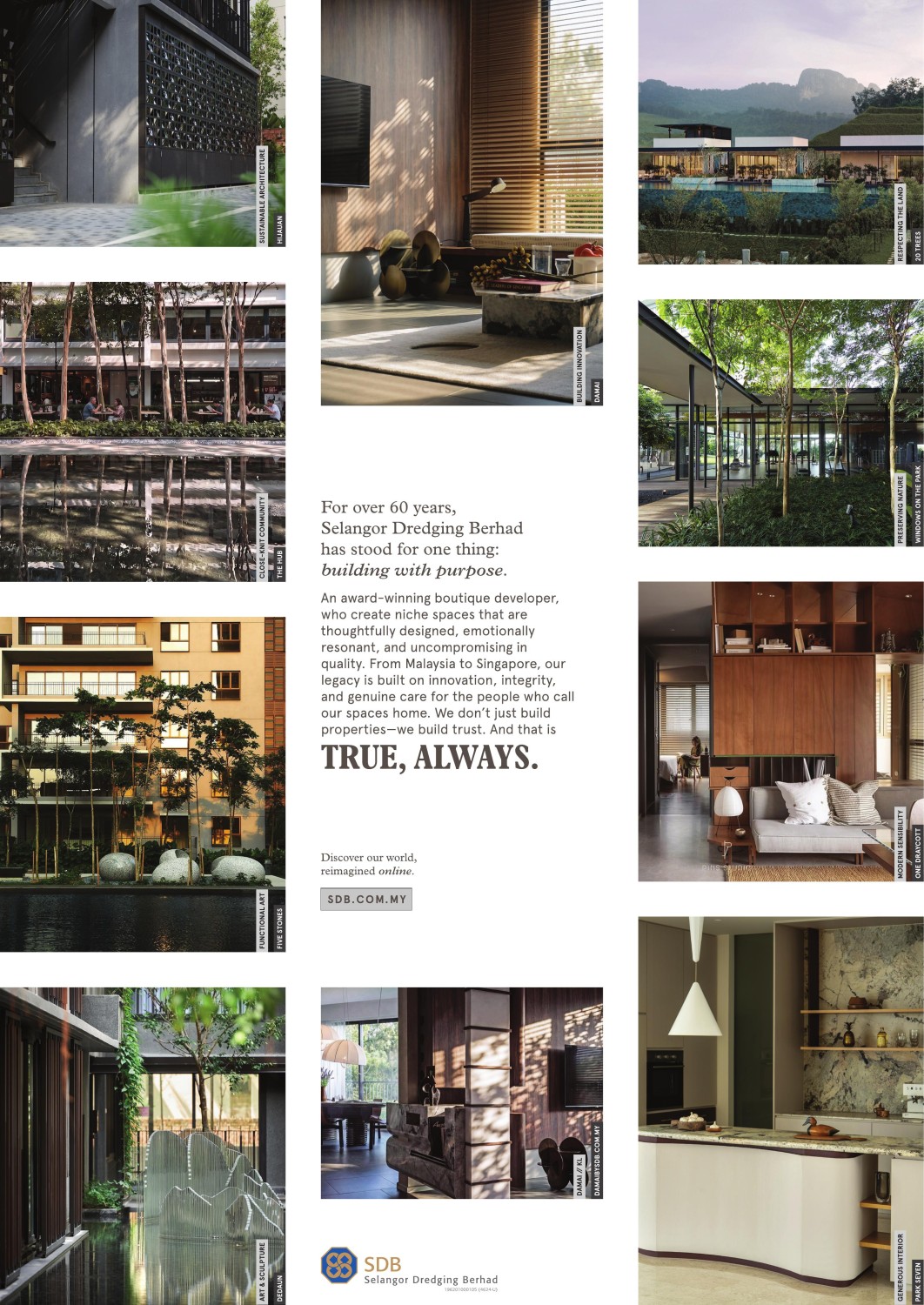
It represents an understated promise, but one that carries a deeper meaning. TRUE is about knowing what matters and making decisions that remain faithful to it. ALWAYS is about having the discipline to stay true to those decisions and commitments, consistently over time.
For SDB, it is not a tagline that is merely added on top of what SDB does – but it is a description of what SDB has already been doing. It is more than a new expression of the brand. It reflects a way of doing business shaped over more than six decades, including more than two decades in property development across Malaysia and Singapore.
Throughout that journey, the principle has remained simple: to be thoughtful about the places we create, to build with intention, and to remain uncompromising about the things that matter most to the people who call them home.
Knowing What Truly Belongs
Being TRUE means having the restraint to do what is right – knowing what is necessary, what matters, and what truly belongs.
Every site has its own character. The surrounding landscape, neighbourhood, climate, people and the way they move through their daily lives all shape what a development should become. Good development therefore cannot simply be about taking a formula that worked somewhere else and applying it again.
Thoughtful design begins with observation.
At DaMai, as with SDB’s earlier developments in Taman Melawati – 20Trees, 20Trees West and 19Trees – the natural setting around Bukit Tabur and the Klang Gates Quartz Ridge is more than a backdrop. It is an integral part of the way these developments are conceived, designed and experienced. The landscape informs their identity, influencing everything from the way the homes are positioned to how residents experience the surrounding greenery.
At Elina Resort Homes in Taman Putra Perdana, Puchong, the lakeside setting similarly forms part of the experience rather than something added afterwards. The three-storey strata link villas build on SDB’s experience with the strata terrace concept at Jia in Taman Bukit Serdang and 19Trees, while responding differently to their suburban setting. Here, the lake, landscape and community spaces help shape how the development is experienced.
The point is not to make a development look different for the sake of being different. It is to make it feel like it belongs.
Perhaps this is one of the most important forms of restraint in property development: knowing what a place is asking for before deciding what to put there.

Designing for How We Truly Live
The same thinking applies to the home itself.
A floor plan can look efficient on paper, but that does not necessarily mean it will be lived well. A beautifully rendered clubhouse may attract attention, but that does not mean it will become part of people’s everyday lives. And while a long list of facilities may sound impressive, what matters is whether those spaces genuinely add value to people’s living experience.
Good design begins with empathy – by understanding how people actually live.
How families come together, or how they spend time apart. Where children play. Where parents work. Where friends gather. How people move through a home in the morning, or unwind at the end of a long day.
These are ordinary things, but they are also the things that matter most. Some of the most meaningful design decisions may therefore be the ones that are least obvious. It could be the way a living and dining area is placed to encourage families to spend more time together. It could be a shaded walkway that makes an afternoon walk more comfortable. It could be the decision to preserve greenery rather than maximising every available square foot.
None of these decisions necessarily makes the loudest headline. But together they can make a meaningful difference to how a place is experienced every day.
That is where restraint becomes important. It is not about removing things simply to do less. It is about making every decision count.

True Craftsmanship & Quality Go Beyond What You See
There is another side to restraint that is less visible: craftsmanship and quality.
Homebuyers naturally notice what they can see and touch. The façade. The finishes. The fittings. The landscaping.
But much of what determines whether a home continues to perform well over time happens long before the homeowner moves in. It is in the planning, coordination, testing and quality assurance. It is in the details checked during construction, the decisions made when something is not quite right, and the willingness to correct an issue rather than accept something that is merely good enough.
Doing it right the first time is rarely the most dramatic part of property development. But it can be one of the most important.
This is why quality is not necessarily about choosing more expensive materials or adding more elaborate features. Sometimes, it is simply about having the discipline to get the fundamentals right – and to do them well.
The things that homeowners see are only part of the story. The standards, processes and attention to detail behind them are what help ensure that what is delivered continues to perform as intended.
True craftsmanship is therefore not just about how something looks when it is completed. It is about the care that goes into getting it right in the first place.

When Innovation Has a True Purpose
Being TRUE also means knowing when to innovate – and why.
Innovation in property can sometimes become an end in itself. New technology, new materials and new concepts can create excitement, but novelty alone does not necessarily make a home better.
The more useful question is: what problem are we solving, and how does it make everyday life better?
At DaMai, the Parking-At-Your-Doorstep concept is an example of innovation responding to a practical aspect of daily living. The idea is not simply to introduce a different parking system, but to make the journey between car and home more direct and convenient for homeowners.
This philosophy of innovation has long been part of SDB’s approach to development. Rather than following a fixed formula, each development is shaped by its own site, context and the people it is designed for. That creates opportunities to challenge conventional thinking, introduce new ideas and rethink what a residential development can offer.
Innovation, in this sense, does not always mean inventing something that has never been seen before. Sometimes, it means looking at a familiar problem differently. Sometimes, it means refusing to assume that the solution that worked somewhere else is automatically the right solution here.
For SDB, innovation matters when it improves the living experience. Otherwise, it is simply another feature.

Keeping the Promise, Always
Perhaps the more difficult word in SDB’s new brand expression is not TRUE, but ALWAYS.
Making a promise is easy. The harder part is keeping it – consistently, over time and when there are countless moving parts behind the scenes.
In property development, a promise is rarely made to just one person. A development involves homeowners, consultants, contractors, authorities, business partners, employees and many others, all working towards the same outcome. At the centre of it all is the developer, such as SDB – the one expected to bring everything together and ultimately take responsibility for what is delivered.
For homeowners, that responsibility is tangible. It can mean delivering a home when it is supposed to be delivered. It means ensuring that the quality meets the standards that were promised. It means that what they saw, understood and believed in when they made the decision to buy is reflected in the home they eventually receive.
For consultants, contractors and business partners, it means providing clarity, making decisions and keeping the development moving. For employees, it means creating an organisation that takes ownership of its commitments rather than passing responsibility from one party to another.
A development can take years to move from an idea on paper to a place people can call home. Along the way, there are decisions to be made, challenges to solve and timelines to manage. Circumstances can change, but the responsibility to honour a commitment does not disappear simply because delivery becomes difficult.
This is where trust is built.
When homeowners choose a developer, they are placing their confidence in someone to bring together hundreds of decisions, people and processes to deliver something that may be one of the most significant purchases they make. They are trusting that the developer will do what it says, meet the commitments it makes and take responsibility when things do not go according to plan.
That is why SDB sits at the centre of the relationship. Being trusted means taking that responsibility seriously – keeping commitments, meeting promised timelines, maintaining standards and being accountable for the outcome.
For over 60 years, SDB has stood for one thing: growing with purpose, not just profit. An award-winning boutique developer, who creates niche spaces that are thoughtfully designed, emotionally resonant, and uncompromising in quality. From Malaysia to Singapore, our legacy is built on innovation, integrity, and genuine care for the people who call our spaces home.
We don’t just build properties – we build trust. And that is – True, Always.